
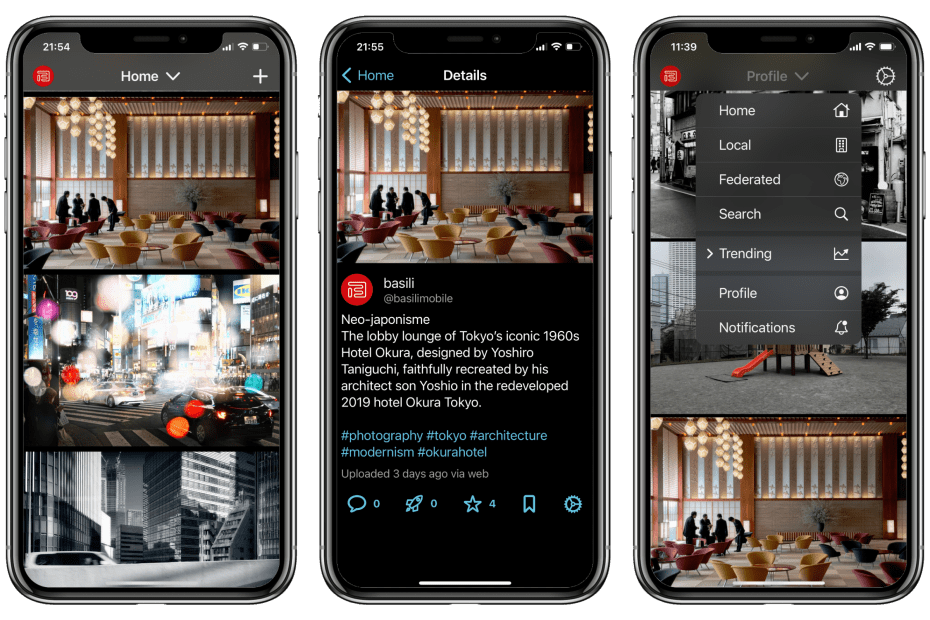
In my very first post here I bemoaned the decline of Instagram. The addition of this blog to my website came about because of this and trials with other contenders — 500px, Flickr, vsco, EyeEm, Tumblr, et al — that didn’t cut it for me. Now there’s a new possibility. Though Pixelfed has been around since 2018, I somehow only discovered it days ago. I have been trying Pixelfed out through the dedicated Vernissage iOS app and it’s largely through this prism that I will discuss my experience.
As Mastodon is to Twitter/X, so Pixelfed is to Instagram: a free, open source, decentralized photo and video sharing platform. Pixelfed works through a browser or as a web app, though native apps for Android and iOS have been in beta mode for some months and will eventually make it to their respective App stores. Pixelfed is also mostly compatible with Mastodon apps, while third party apps are currently available for Android and iOS. As I said, I am using the iOS app Vernissage. It’s a beautiful app: elegantly designed, free of clutter and so far, like Pixelfed itself, free of ads and spam, algorithms and data-mining, brands and influencers. It’s all about shared photos and artwork and, though I’ve yet to see any, videos. I’d like to think it’s pretty much like Instagram was in the good old days; of course that’s not really possible. The zeitgeist has changed since 2010 when Instagram arrived and it was novel, as were smartphones, and cat photos, selfies and memes had yet to become ‘things’. There wasn’t much of a community, and using it was simple — and fun. Pixelfed through Vernissage is a lot like that. It has the kind of simplicity and low-friction user experience that Instagram got so right in its earlier incarnations.
Scrolling through images or searching hashtags without intrusive promotional materials and gimmicky videos is enjoyable and brings to mind the simpler times of the nascent mobile internet.
Pixelfed is a social network, so there are Follows and Likes, Boosts, Bookmarks and Comments, though in Vernissage the details of these are hidden behind menus, keeping the focus on the images rather than social interactions and statistical validation. Pixelfed has some photo filters, but they are not in Vernissage. Users can post a photo or video, or an album of several photos totalling 15MB in size. In Pixelfed’s own app posting a larger collection of photos is also possible. Users can search via hashtags or for other users or they can scroll through trending images. There are privacy features such as muting, blocking and reporting accounts or disabling comments.
Pixelfed works much like Mastodon, with various federated instances hosted by different people in different places. Feeds, of which there are four, are satisfyingly chronological: Local – shows images from users on the same instance (pixelfed.social in my case); Federated – from users on other instances, including from Mastodon, so this feed can get cluttered with non-photography-related posts; Home – collected images posted from users you are following and your own posts, and Trending, as mentioned above, which also shows trending tags and accounts. Here too, there are plenty of non-photography-related options. To keep a focus on photography, I only move between Home, Local and Trending Photos feeds.
Of course, with under 200,000 users, Pixelfed currently doesn’t have the depth of photography that Instagram and Flickr before it had, and much of what I’ve seen doesn’t interest me — there are plenty of landscapes, birds, and bugs filmed with macro lenses. And there are cats. My account came with 7GB of server storage. Other instances may differ. I guess photos will be, or need to be, deleted should I reach that limit.
Pixelfed is unlikely to ever reach the heights of Instagram but that’s probably no bad thing. A relatively small but engaged and focused community makes for a calmer, more enjoyable networking experience. And Vernissage is a beautiful app that makes using Pixelfed a pleasure, just like Instagram used to be. I don’t know if I’ll stay, but for now it’s worth exploring.
Update: Vernissage is now called Impressia.
 basili mobile images